SMU Student Nurses Support Heart Health Through Hypertension and Wellness Sundays
During National Heart Health Month, heart disease prevention takes center stage at Allen Temple Baptist Church in East Oakland. For over two decades, Samuel Merritt University’s (SMU) Ethnic Health Institute has hosted Hypertension and Wellness Sundays in partnership with the Health Ministry network, composed of over 25 predominantly Black faith-based institutions. Over the years, thousands of congregants and community members in the Bay Area and beyond have been screened, educated, and empowered.
Over 25 years ago, Dr. Frank E. Staggers, Sr. MD—community advocate and founder of SMU’s Ethnic Health Institute (EHI)—chose the last Sunday in February to focus on hypertension screening and education in honor of Black History Month and National Heart Health Awareness month. Originally created to address cardiovascular diseases as the leading causes of death, Hypertension and Wellness Sundays reflects a shared commitment to educating nurses and providing community care.
Community Care at Hypertension and Wellness Sunday
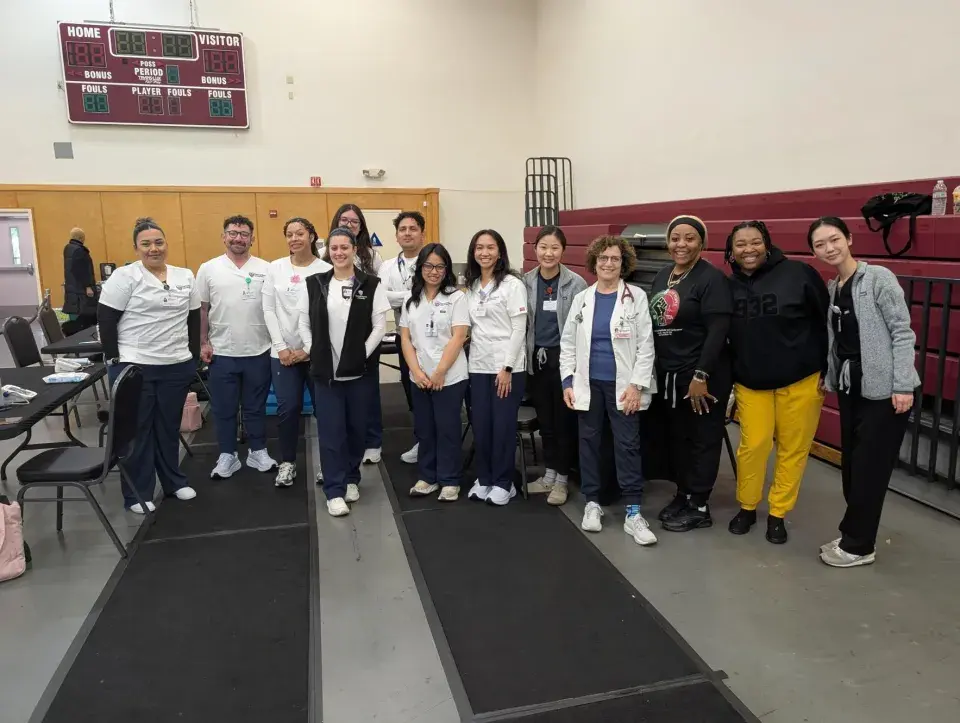
At one of 22 Hypertension and Wellness Sunday events held in six counties this February, approximately ten first-year Bachelor of Science in Nursing (BSN) and Accelerated Bachelor of Science in Nursing (ABSN) students from SMU’s Oakland and San Francisco Peninsula campuses volunteered at the church, conducting blood pressure screening and providing health education. For some participants, the screening confirmed a known condition; for others, it offered a first indication that their blood pressure may be elevated.
In addition to blood pressure screenings, tables offered education and resources on the major factors that influence heart disease, including nutrition, exercise, sleep and kidney health. After each screening, community members had the opportunity to speak with volunteers about their results and receive referrals to local clinics or providers if follow-up care was needed.
The event not only provided immediate information, but also helped bridge gaps in access to care. Events like these also address the disproportionate impact of heart disease on the African American community, highlighting the need for knowledge and resources to manage the condition.
Student Nursing Experience
Students from SMU gain practical experience in community health by participating in these events. They learn to counsel patients, measure blood pressure accurately, and understand the importance of addressing hypertension early to prevent long-term damage.
For SMU students, Hypertension and Wellness Sundays offer an early and eye-opening introduction to care beyond hospitals. Tavi Baker, Associate Director for SMU’s Center for Community Engagement and Manager of the Ethnic Health Institute, spoke to the educational value of the initiative, stating, “for many students, this is their first community blood pressure screening experience, and they’re able to relate to participants on a more personal level outside of a clinical setting.”
The experience builds both technical and interpersonal skills for student nurses. In addition to practicing blood pressure assessment, students learn how to ask open-ended questions and counsel patients on everyday lifestyle changes that keep blood pressure in check.
Jonathan Elvira, first-year BSN student at SMU Oakland’s campus, said the face-to-face conversations helped ease nervousness and strengthen his communication skills, preparing him for future clinical practice.
Assistant Professor of Nursing at SMU, Marjorie Hammer, observed how “students themselves get really focused on the hospital, and they always get really interested in the emergency room and ICU,” but she hopes to broaden their perspective. “People who go to the emergency room often are people who are not getting the help that they need beforehand,” she said, emphasizing the importance of community health in preventing crisis care.
For Nubia King, a retired nurse who has helped organize events with the Allen Temple Health Ministry for over two decades, that broader lens is exactly the point. “Care is not only in a hospital,” she said.
Nhi Phung, an ABSN student at SMU San Francisco Peninsula, echoed this sentiment, “as a nurse, you not only care for the patient in the hospital, but you also care for your community.” For her, learning patients’ daily routines and realities outside clinical settings is essential to becoming a well-rounded nurse.
These are the kinds of impressions that SMU staff like Tavi Baker know will shape SMU students into compassionate healthcare providers, remarking that “these interprofessional community health events are a key part of SMU's and EHI's mission.”
Importance of Community Outreach
At the heart of Hypertension and Wellness Sundays is a simple but urgent message: hypertension is often invisible until it’s too late. “One of the things that I always emphasize is that hypertension is a silent killer,” said Professor Hammer. Over time, uncontrolled high blood pressure can quietly damage the brain, heart, kidneys and blood vessels, impairing both longevity and quality of life.
Professor Hammer noted that more than half of those screened at the event have hypertension that is not well controlled, underscoring how critical it is to catch the condition early—particularly in the African American community, where rates of hypertension remain disproportionately high.
That reality is one Nubia King, organizer with the Allen Temple Health Education Ministry, sees firsthand. During Hypertension and Wellness Sundays, some participants discover for the first time that their blood pressure is dangerously high. “They’ve been walking around with really high blood pressure, ready to have a stroke,” she said.
For many attendees, the church setting removes barriers that might otherwise prevent them from seeking care. “It’s a more relaxed environment where they can interact with healthcare providers and get their questions answered in a familiar and positive setting,” explained Baker.
ABSN student at SMU San Francisco Peninsula’s campus, Anna Torres, found value in understanding how community members view their health and how those perspectives translate to hospital care. With this kind of community centered care in mind, Torres reflected on the opportunity to offer education alongside blood pressure screenings—a chance to “fill in the gaps” in patient knowledge.
Students counseled attendees on lifestyle changes as small as taking walks during lunch breaks or adjusting their diet. “Little changes make a big impact,” said Torres. As King put it, “you can be screened for high blood pressure, but if you don’t have the knowledge of how to fix it, it doesn’t work.”
Reflecting on the overall importance of community care, Baker voiced how “community members really appreciate seeing SMU students and faculty showing up in their neighborhoods and places of worship.” Elvira agreed with this sentiment, commenting that “it's important for the members here to know that they're being taken care of.”
SMU's Continuing Partnerships
“Oakland has the greatest prevalence of high blood pressure in Alameda County, so it’s important to continue to partner with faith-based organizations here in Oakland and throughout Northern California,” says Baker.
Through our Health Ministry network, SMU is proud to provide the majority of the screening sites through Alameda County’s Happy Heart campaign where we distribute free wrist monitors to participants with elevated blood pressure who don’t have devices at home.
The Hypertension and Wellness Sunday initiative is funded, in part, by a generous grant from the Clorox Company Foundation. To learn more about Clorox’s support of partnership with the University, read this SMU News story about the grant.