The Architect of Expansion: Abby Heydman and the Evolution of SMU

Shortly after Samuel Merritt College (now Samuel Merritt University) began offering bachelor’s degrees in nursing in the 1980s, consultant Abby Heydman, PhD, looked around and noticed the small enrollment. The college needed to expand, but in what way?
A nurse by training who later became an administrator, Heydman did what all excellent nurses do – she identified gaps in patient care and proposed solutions. She knew there needed to be more programming available to meet the needs of patients in the East Bay and beyond. And she understood that the ripple effect of excellent clinicians graduating from Samuel Merritt University (SMU) would only be enhanced by identifying timely and needed pathways in other programs outside nursing, such as physical therapy (PT). Before long, Heydman was visiting existing PT programs across the state and conducting feasibility studies to see if the program could be added to SMU’s offerings.
Heydman recognized that sustainability would be the key to success. So with each program created, she considered how it would grow and evolve with the times. Heydman also knew that interdisciplinary programming in higher education was the future and that SMU had the opportunity to grow in new and exciting directions.
“I was really an advocate for interprofessional education,” said Heydman, who eventually became SMU’s academic vice president. “Everybody has to learn how to use research because these are all research-based programs. Everybody has to learn how to communicate with patients. It’s important for people to learn to work together and understand what are the different roles for providers and how they differ and complement each other.”
Dr. Paulina Van, now Professor Emeritus at SMU, says that working alongside Dr. Heydman was both an intellectual partnership and a profound professional gift during this time of growth and expansion at SMU. “She generously shared her expertise, asked the questions that sharpened my thinking, and upheld a standard of scholarly rigor that elevated everyone around her. She embodied the highest ideals of nursing scholarship and leadership, never losing sight of the human beings at the heart of every policy decision, curriculum revision, and research question.”
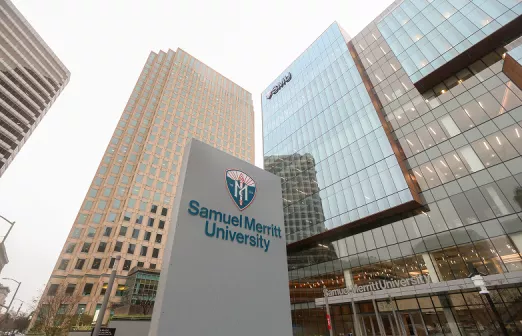
Heydman’s work in creating and growing non-nursing programs laid the foundation for what eventually became SMU’s College of Health Sciences. Her forward-looking approach continues today. In January, the university opened its new flagship campus in downtown Oakland, a tangible symbol of its commitment to the city of Oakland and to the future of healthcare education. With the new space, SMU will be able to double its enrollment, both through growing existing nursing and non-nursing programs and by adding programs across the healthcare landscape. Next, needing more space for a growing student population, the San Francisco Peninsula Campus made a move to Foster City to prepare for doubling the number of students in the next five years.
“That evolution from a nursing institution to now a university that looks across the spectrum of health services was somewhat of a natural evolution,” said Provost Brian Clocksin. “There’s so much overlap and integration between disciplines that when you look at healthcare, it’s really a team approach. And that team approach lends itself well to us as an institution. How do we make sure we’re preparing a workforce that can serve within that team approach?”
SMU has evolved tremendously over the past century. Founded in 1909 as a training school for nurses within the then-Samuel Merritt Hospital, the school trained nurses using what was considered standard at the time — through a hospital-based nursing school. The school granted three-year certificates in nursing but by the 1970s, nursing education was moving in a different direction.
Dean Emeritus for SMU’s College of Nursing, Dr. Audrey Berman, started working at Samuel Merritt in 1977, and has known and worked with Dr. Heydman for almost 50 years. “Abby had the passion and expertise to move us from a 70-year-old diploma program into a degree-granting institution with the BSN, then MSN, then PT, OT, podiatry, and other degrees. Her knowledge of higher education, accreditation, and finance was essential in making those new endeavors possible. She navigated often stormy waters to reflect our institutional history while working with numerous healthcare organizations, accreditors, and other colleges. And through it all – and there were plenty of successes and falters - Abby never lost sight of the individual: student, faculty member, or staff person. For her, an open-door policy was de rigueur. She always honored others and celebrated milestones and accomplishments. She shared her time, her family, and her career with us.”
Associate degree programs in nursing were gaining in popularity as were four-year degrees in nursing. SMU leaders at the time determined that a bachelor’s degree in nursing was the right approach for the school and to move in that direction, it first became an accredited college. It was among the first hospital schools of nursing in the nation to do so.
Heydman was a consultant for that process. After the college was accredited, she helped establish the Intercollegiate Nursing Program, a joint program with St. Mary’s College that offered students a joint bachelor’s degree in nursing. The program proved successful, but the school still struggled with low enrollment. To fully provide the level of services students and patients needed, Heydman said, the school had to grow to at least 1,000 students. That’s when she began to look beyond nursing and focused on PT, developing a checklist of things that were critical to consider in the development of a program. By 1990, SMU added its first non-nursing program with a master’s program in physical therapy, eventually converting it to a doctoral program. “Abby could recruit people to get work done - no matter what it was. That is what she’s great at doing. It’s in her DNA, her way of living life and projecting into the world…all done positively and with a big smile,” says colleague and former clinical faculty for Kaiser and instructor with SMU, Bobbie Richards, MA, RN.
Momentum picked up after the PT addition and within a few years, SMU established graduate programs in nursing, including specializations in family nurse practitioner (FNP) and nurse anesthesia. It soon also added a master’s program in occupational therapy (MOT) and then a physician assistant (PA) program in 1999. Together, these non-nursing programs would form the basis of the College of Health Sciences (CoHS).
“This change not only made sense from an academic standpoint, but it really reflected the needs of the community,” said former provost Fred Baldini, who oversaw the creation of the CoHS and says his work built on Heydman’s accomplishments. “Samuel Merritt [University] evolved from having a nursing-only focus to having a really comprehensive health professions focus. With this interdisciplinary approach to healthcare, all these different disciplines are working together in some way. It was an important move and it happened in a relatively short period of time.”
Today, the CoHS offers a bachelor’s program, five master’s programs, and two doctoral programs. The college continues to look ahead, and recently merged the PT and OT programs into the Department of Rehabilitation Sciences within CoHS. Additionally, the master of biomedical sciences (MBS) program launched in fall of 2025 and the college has multiple new programs planned for the next several years, including the launch of a master of marriage and family therapy (MFT) program and potential future programming includes masters of medical imaging or a master of science in anesthesiologist assistant.
“Our first priority is looking at how we make a difference,” said Sathees Chandra, dean of the College of Health Sciences. “In growing our programs, we are confident we can be successful. We have the connections, we have the resources, we have the best people on staff, and excellent administration.”
“It’s an exciting time both for the college and the university as a whole”, said Sharon Gorman, chair and professor in the Department of Physical Therapy, and Interim Chair, Department of Rehabilitation Sciences. “Adding new programs, growing existing ones, and bringing them all together under one roof of the new Oakland campus are bold moves that will benefit students, healthcare education, and, ultimately, patients”, she said.
Not only will these changes encourage even more collaboration among departments, but also among students, who are now crossing paths with future colleagues across disciplines as they go about their days. That means students will be trained interdisciplinarily, working together to create better patient outcomes. The Health Sciences Simulation Center at the new SMU Oakland campus offers scenarios for students to work on in an interdisciplinary manner, including in a hospital setting, community clinic setting, and even an in-home setting. SMU is uniquely positioned to answer the need for diverse forms of care.
“This is a dynamic and positive period for us,” Gorman said. “We’re looking to do things in a new and different way and we are stepping up to the different challenges being faced in healthcare and healthcare education.”
In 2001, Heydman, née Hitchcock, and her husband Frank also founded the Hitchcock Heydman Endowed Scholarship Fund to help others pursue a healthcare education through scholarships. She reflected, "As we began to develop new health science programs at Samuel Merritt [University], it became clear that scholarship funds were needed for students in these new programs. Frank and I felt it important that we help offer scholarship support for these students. Both of us have benefited from private scholarships and federal funding for our health science careers, and we know first-hand the benefits such funding provides."
If you would like to learn more about supporting the Hitchcock Heydman Endowed Scholarship Fund you may contact SMU’s Advancement team at advancement@samuelmerritt.edu. If you are a student enrolled in graduate nursing, occupational therapy, physical therapy or the physician assistant program and are interested in applying, please contact Financial Aid at finaid@samuelmerritt.edu.