Master of Social Work
SMU’s Master of Social Work (MSW) program prepares graduates to work as respected members of interdisciplinary teams that provide health services and social services that enhance people’s quality of life.

SMU’s Master of Social Work (MSW) program prepares graduates to work as respected members of interdisciplinary teams that provide health services and social services that enhance people’s quality of life.

The MSW program offers comprehensive training for integrated health, behavioral health, and medical social work. It’s a three-year, part-time program with a blend of online and in-person learning, focusing on addressing social determinants of health and promoting social justice in healthcare teams.

SMU’s Oakland-based Master of Social Work program provides a unique blend of social work and advocacy training in the culturally rich Bay Area, emphasizing ethical practice and a commitment to social justice.

Studying at SMU ensures a prosperous career. We’re the #1 university in CA for post-grad jobs, with 86% of employers preferring our grads. Forbes ranks us #1 for early-career salaries, and The New York Times recognizes us as one of the top two universities nationwide for median income ten years after graduation.
Samuel Merritt University Master of Social Work Program Receives CSWE Accreditation July 6th, 2026
Samuel Merritt University is pleased to announce that its Master of Social Work (MSW) program has been granted Accreditation for a period of eight years by the Council on Social Work Education's (CSWE) Board of Accreditation (BOA).
The accreditation decision affirms that the MSW program meets the rigorous standards established in the 2022 Educational Policy and Accreditation Standards (EPAS) and has successfully completed the comprehensive accreditation review process required of all new social work programs.
CSWE accreditation is the national standard for professional social work education and provides students, employers, and community partners with assurance that graduates have completed a program that meets nationally recognized standards for preparing competent social work professionals.
This milestone reflects the dedication of the program's faculty, staff, students, practicum partners, alumni, advisory board members, and university leadership, whose collective efforts helped establish a high-quality, innovative graduate social work program committed to preparing the next generation of social workers.
For more information about the Council on Social Work Education's accreditation process and the Board of Accreditation's accreditation decisions, please visit the CSWE Board of Accreditation Decisions page and review our program’s status in CSWE’s Directory of Accredited Programs. For more information about social work accreditation, contact CSWE’s Department of Social Work Accreditation.
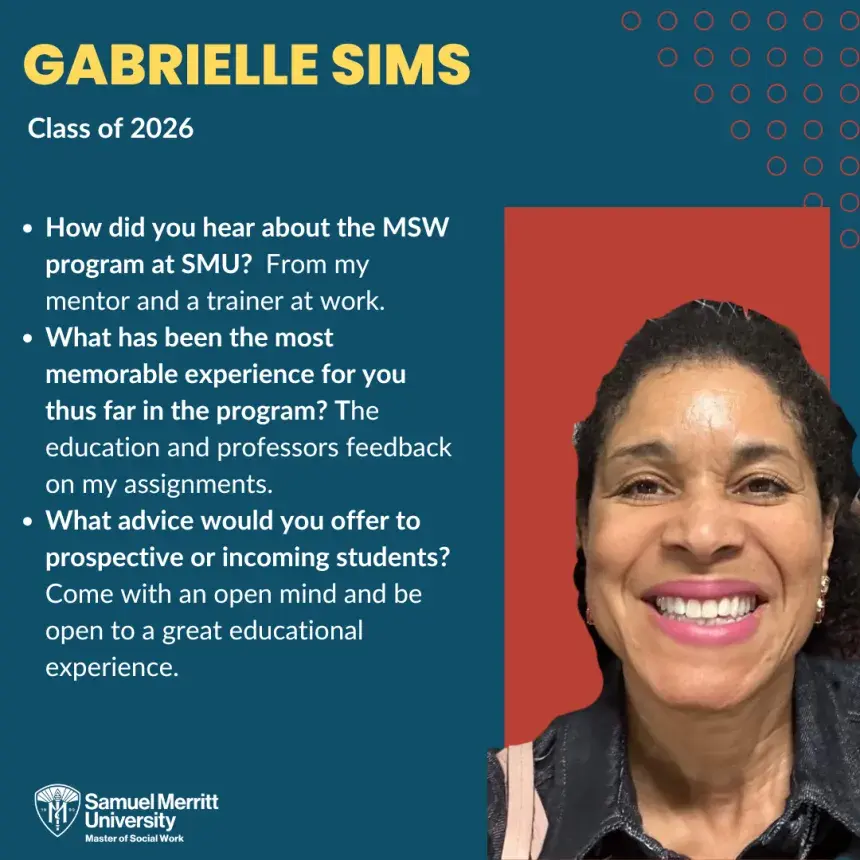
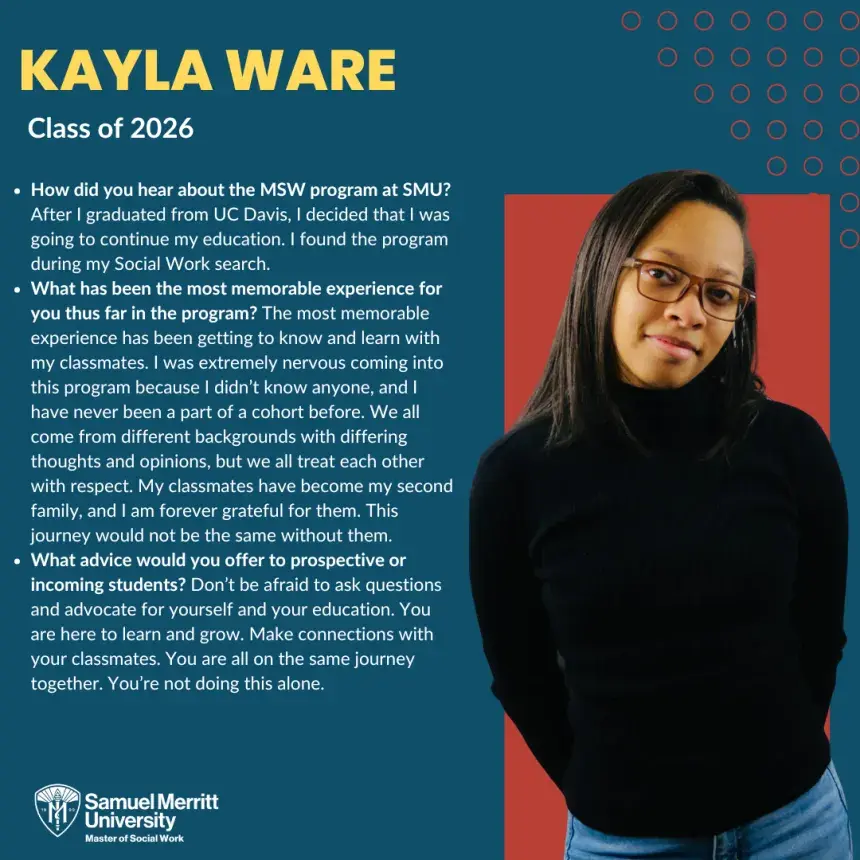
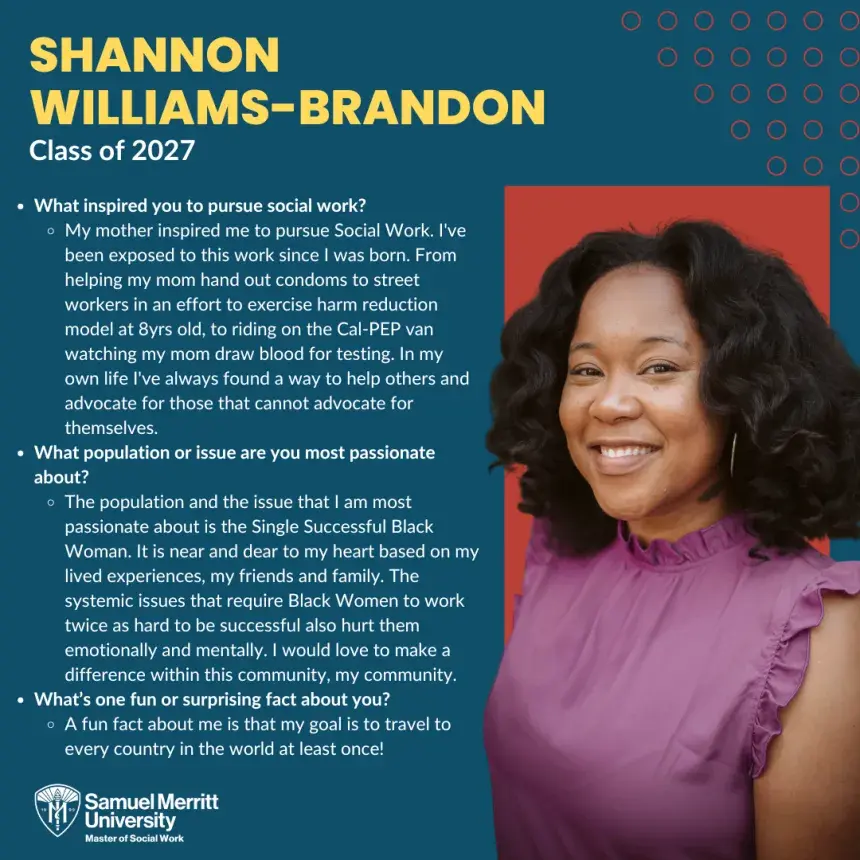
A special thank you to our first three cohorts of students:
Consistent with CSWE accreditation policy, Initial Accreditation applies retroactively to all students who entered the program during its candidacy period. As a result, graduates who completed the Samuel Merritt University MSW program while it held CSWE Candidacy status are considered graduates of a CSWE-accredited social work program.
We extend our deepest gratitude to the students in our first three cohorts, who chose to place their trust in a new program during the candidacy process. Their confidence, resilience, and commitment helped shape the culture and identity of the Samuel Merritt University MSW program. As our pioneering students, they partnered with our faculty, staff, and administration in building a program dedicated to excellence in social work education.
SEQUENTIAL COURSE CURRICULUM COURSE DESCRIPTIONS
Our curriculum is informed by the Council on Social Work Education (CSWE) 2022 Educational Policy and Accreditation Standards. Our courses are designed to provide students with the knowledge, skills, and abilities to achieve our previously defined MSW mission, goals, and objectives.
Introductory and Generalist courses are taken in the first year and parts of the second year of study. These courses build the foundation for advanced specialization in integrated health/medical social work in parts of the second year and the third and final year of the program.
A Typical Course Schedule
The SMU MSW program offers one area of specialized practice in integrated health, behavioral health, and medical social work. The focus of our program is to graduate social work professionals who are prepared for service in integrated health care (IHC) and a variety of healthcare settings.
Classes are designed to complete the part-time program in three years.
The Generalist Practice curriculum is completed in the first two years of the program and is organized around six areas: (1) Human Behavior in the Social Environment (SW601 and SW602); (2) Social Welfare Policy (SW620); (3) Introductory Research (SW6615); (4) Diversity/Race Gender & Inequality in Health (SW622); (5) Generalist Practice (SW611 and SW612); and (6) Field Seminar and Internship (SW630a and b, SW631a and b).
Our specialized practice curriculum is completed in the advanced years of the program. The specialized practice is designed to address advanced competencies in integrated health, behavioral health, and medical social work that are aligned with the nine social work competencies as defined by CSWE.
36 Month Design (8 semesters)
Year | Fall Semester | Spring Semester | Summer Special Session |
1 | Semester 1 SW601 HBSE I: Human Behavior in the Social Environment I, Micro and Mezzo (3 units, Hybrid On Campus) SW615 Research Methods I: Intro to Social Work Research (3 units, Hybrid Online) | Semester 2 SW602 HBSE II: Human Behavior in the Social Environment II, Mezzo and Macro (3 units, Hybrid On Campus) SW620 Intro to Social Welfare Policy (3 units, Hybrid Online) | Semester 3 SW622 RGI: Racial, Gender & Inequality in Health and Mental Health (3 units, Hybrid On Campus) SW650 Elective I: The Recovery and Empowerment Models in Social Work practice: Electives (3 units, Hybrid Online) |
2 | Semester 4 SW611 Generalist Practice I: Micro Practice (3 units, Hybrid On Campus) SW630a Practicum Seminar I (1 unit, Hybrid On Campus or Online) Must be taken concurrently with practicum training | Semester 5 SW612 Generalist Practice II: Mezzo and Macro Practice (3 units, Hybrid On Campus) SW631a Practicum Seminar II (1 unit, Hybrid On Campus or Online) Must be taken concurrently with practicum training | Semester 6 SW613 Advanced Micro Practice In Integrated Health/Medical Social Work (3 units, Hybrid On Campus) SW651 Elective II (3 units, classes may be online or on campus based on instructors’ availability) |
Practicum Options: | Option A: 16hrs/week 15 weeks per semester = 225-240 hrs (3 units, Agency Placements) | Option B: Summer Block placement 40hrs/week, 12 weeks in Summer = 450-480 hrs (6 units, Agency Placements) | Option C: Extended 42-week 3 Semester Block = 425-450 hrs (6 units total, Agency Placements) |
3 | Semester 7 SW614 Advanced Mezzo and Macro Practice in Integrated Health/Medical Social Work (3 units, Hybrid On Campus) SW616 Integrated Seminar: Integrated Health/Medical Social Work Research I (3 units, Hybrid Online) SW632a Field Seminar III: Interprofessional Education (IPE) Simulation Training (1 unit, Hybrid On Campus) | Semester 8 SW617 Integrated Seminar: Integrated Health/Medical Social Work Research II (3 units, Hybrid Online) SW633a Practicum Seminar IV: Interprofessional Education (IPE) Simulation Training (1 unit, Hybrid On Campus) | Special Summer Electives will be offered in the summer sessions*. These electives will help prepare students to complete California BBS requirements. Classes may include: • Law and Ethics • Human Sexuality / Taking a Sexual History/Gender Affirming Care • Substance Abuse Treatment *There are non-tuition special fees for some of these courses |
Practicum Options: | Option A: Two Semester Placements, 16 hrs/week, 30 weeks over 2 semesters = 225-240 hrs x 2 semesters = 450-480 total hrs (6 units total, Agency Placements) | Option B: Summer Block placement, 40 hrs/week, 12 weeks in Summer = 450-480 total hrs (6 units, Agency Placements) | Option C: Extended 42-Week 3 Semester Block = approximately 12 hrs/week in 3 semesters = 450-480 total hrs (7 units, Agency Placements) *Additional tuition may apply for a 9th semester. |
Typical Class Schedules
Hybrid Online: Classes will meet via Zoom class sessions on weeknight evenings. Most classes will meet for two to three hours on Tuesday, Wednesday, or Thursday evenings beginning at 6:30 PM.
Hybrid On Campus: Classes will meet for a mix of in-person and online coursework. In-person classes will be held on Saturdays at SMU’s Oakland campus. On-campus courses will begin at 9:30 AM, with some additional afternoon sessions if two on-campus sessions are needed. (This will occur in the 3rd year of the program, with both advanced practice and Simms labs occurring on same days, and some afternoon electives may be offered on campus.)
Courses
Practicum Placements: Held at different medical, behavioral health, and nonprofit settings. All students are expected to complete 900 hours of internship placements. Students will work under the supervision of MSW providers who have a minimum of two years’ post-master’s practice experience.
Application Fees
Application fees are payable to Social Work’s Centralized Application Service (SocialWorkCAS). Samuel Merritt University does not charge an additional admission fee. The SocialWorkCAS fees support delivery of transcripts to Samuel Merritt University.
Application Fee = $45
Non-Refundable Deposits and Fees
Students offered admission pay a non-refundable tuition deposit of $350 to secure their seat in the class. Application fees and tuition deposits are non-refundable, whether or not the student withdraws in the first week of the term.
Tuition
For a detailed summary of annual tuition, all fees for the program, and a cost estimator for the entire program, visit Student Accounts.
MSW Scholarships
Some university scholarships are available. The awards will be made on a rolling basis. Early applications are encouraged for students interested in scholarships. Awards of $3,000 to $5,000 are available. Approximately 5 to 10 awards will be made each year. Complete applications on the SocialWorkCAS website are required before scholarships can be awarded.
The state of California offers behavioral health scholarships to increase the number of appropriately trained behavioral health professionals providing direct patient care in California. Scholarships of $20,000 per year are available for a post-graduation service obligation. Students must be enrolled in an MSW program to apply. Early admission applications are encouraged for students who plan to apply for HCAI scholarships. It is strongly advised that you attend the MSW department's monthly Q&A sessions to help you prepare your scholarship application.
Financial Aid
In addition to scholarships, financial aid is an important resource to help cover your education costs. Our financial aid office is available to work with you to put the best possible financial plan together. Available loan types:
Detailed information about financial aid, budgeting, total cost, and application processes is available using the button below.
Debt Forgiveness
Social workers who work for qualifying government or nonprofit organizations often qualify for the Federal Student Loan Forgiveness Program. You may want to compare the type of loans you apply for in relation to the Federal Student Loan Forgiveness Program (only certain loans qualify for debt forgiveness under this program). https://studentaid.gov/manage-loans/forgiveness-cancellation/public-service
Applying for Federal Student Aid
To apply for federal student aid, make sure you complete the Free Application for Federal Student Aid (FAFSA) form each year you are in school. https://studentaid.gov/
News:
Samuel Merritt Receives $1.5M Grant to Begin MSW Program
Questions or Comments? Join Our Facebook Group Here
GRE Scores
Results from the GRE exam are not required or considered for admission into the MSW program.
Internationally Educated Applicants
Students educated abroad may apply for admission. Regardless of previous professional training and academic degrees earned, SMU’s MSW curriculum must be completed in its entirety.
If your education was not part of a U.S.-based study abroad program, all international academic transcripts must be evaluated by a U.S. evaluation service that is a member of the National Association of Credential Evaluations Services (NACES) for degree, course content, semester unit equivalencies, and cumulative GPAs prior to the application deadline. The evaluation must be sent to SocialWorkCAS as part of the application. Information on NACES may be found at www.naces.org.
TOEFL
The need for the Test Of English as a Foreign Language (TOEFL) will be assessed based on information provided by the applicant on the application for admission. If the TOEFL is required, applicants must achieve a minimum score of 100 on the internet-based test. Scores must be submitted during the application process.
The MSW program offers comprehensive training for integrated health, behavioral health, and medical social work. It’s a three-year, part-time program with a blend of online and in-person learning, focusing on addressing social determinants of health and promoting social justice in healthcare teams.
SMU’s Oakland-based Master of Social Work program provides a unique blend of social work and advocacy training in the culturally rich Bay Area, emphasizing ethical practice and a commitment to social justice.
Studying at SMU ensures a prosperous career. We’re the #1 university in CA for post-grad jobs, with 86% of employers preferring our grads. Forbes ranks us #1 for early-career salaries, and The New York Times recognizes us as one of the top two universities nationwide for median income ten years after graduation.
Samuel Merritt University Master of Social Work Program Receives CSWE Accreditation July 6th, 2026
Samuel Merritt University is pleased to announce that its Master of Social Work (MSW) program has been granted Accreditation for a period of eight years by the Council on Social Work Education's (CSWE) Board of Accreditation (BOA).
The accreditation decision affirms that the MSW program meets the rigorous standards established in the 2022 Educational Policy and Accreditation Standards (EPAS) and has successfully completed the comprehensive accreditation review process required of all new social work programs.
CSWE accreditation is the national standard for professional social work education and provides students, employers, and community partners with assurance that graduates have completed a program that meets nationally recognized standards for preparing competent social work professionals.
This milestone reflects the dedication of the program's faculty, staff, students, practicum partners, alumni, advisory board members, and university leadership, whose collective efforts helped establish a high-quality, innovative graduate social work program committed to preparing the next generation of social workers.
For more information about the Council on Social Work Education's accreditation process and the Board of Accreditation's accreditation decisions, please visit the CSWE Board of Accreditation Decisions page and review our program’s status in CSWE’s Directory of Accredited Programs. For more information about social work accreditation, contact CSWE’s Department of Social Work Accreditation.
A special thank you to our first three cohorts of students:
Consistent with CSWE accreditation policy, Initial Accreditation applies retroactively to all students who entered the program during its candidacy period. As a result, graduates who completed the Samuel Merritt University MSW program while it held CSWE Candidacy status are considered graduates of a CSWE-accredited social work program.
We extend our deepest gratitude to the students in our first three cohorts, who chose to place their trust in a new program during the candidacy process. Their confidence, resilience, and commitment helped shape the culture and identity of the Samuel Merritt University MSW program. As our pioneering students, they partnered with our faculty, staff, and administration in building a program dedicated to excellence in social work education.
SEQUENTIAL COURSE CURRICULUM COURSE DESCRIPTIONS
Our curriculum is informed by the Council on Social Work Education (CSWE) 2022 Educational Policy and Accreditation Standards. Our courses are designed to provide students with the knowledge, skills, and abilities to achieve our previously defined MSW mission, goals, and objectives.
Introductory and Generalist courses are taken in the first year and parts of the second year of study. These courses build the foundation for advanced specialization in integrated health/medical social work in parts of the second year and the third and final year of the program.
A Typical Course Schedule
The SMU MSW program offers one area of specialized practice in integrated health, behavioral health, and medical social work. The focus of our program is to graduate social work professionals who are prepared for service in integrated health care (IHC) and a variety of healthcare settings.
Classes are designed to complete the part-time program in three years.
The Generalist Practice curriculum is completed in the first two years of the program and is organized around six areas: (1) Human Behavior in the Social Environment (SW601 and SW602); (2) Social Welfare Policy (SW620); (3) Introductory Research (SW6615); (4) Diversity/Race Gender & Inequality in Health (SW622); (5) Generalist Practice (SW611 and SW612); and (6) Field Seminar and Internship (SW630a and b, SW631a and b).
Our specialized practice curriculum is completed in the advanced years of the program. The specialized practice is designed to address advanced competencies in integrated health, behavioral health, and medical social work that are aligned with the nine social work competencies as defined by CSWE.
36 Month Design (8 semesters)
Year | Fall Semester | Spring Semester | Summer Special Session |
1 | Semester 1 SW601 HBSE I: Human Behavior in the Social Environment I, Micro and Mezzo (3 units, Hybrid On Campus) SW615 Research Methods I: Intro to Social Work Research (3 units, Hybrid Online) | Semester 2 SW602 HBSE II: Human Behavior in the Social Environment II, Mezzo and Macro (3 units, Hybrid On Campus) SW620 Intro to Social Welfare Policy (3 units, Hybrid Online) | Semester 3 SW622 RGI: Racial, Gender & Inequality in Health and Mental Health (3 units, Hybrid On Campus) SW650 Elective I: The Recovery and Empowerment Models in Social Work practice: Electives (3 units, Hybrid Online) |
2 | Semester 4 SW611 Generalist Practice I: Micro Practice (3 units, Hybrid On Campus) SW630a Practicum Seminar I (1 unit, Hybrid On Campus or Online) Must be taken concurrently with practicum training | Semester 5 SW612 Generalist Practice II: Mezzo and Macro Practice (3 units, Hybrid On Campus) SW631a Practicum Seminar II (1 unit, Hybrid On Campus or Online) Must be taken concurrently with practicum training | Semester 6 SW613 Advanced Micro Practice In Integrated Health/Medical Social Work (3 units, Hybrid On Campus) SW651 Elective II (3 units, classes may be online or on campus based on instructors’ availability) |
Practicum Options: | Option A: 16hrs/week 15 weeks per semester = 225-240 hrs (3 units, Agency Placements) | Option B: Summer Block placement 40hrs/week, 12 weeks in Summer = 450-480 hrs (6 units, Agency Placements) | Option C: Extended 42-week 3 Semester Block = 425-450 hrs (6 units total, Agency Placements) |
3 | Semester 7 SW614 Advanced Mezzo and Macro Practice in Integrated Health/Medical Social Work (3 units, Hybrid On Campus) SW616 Integrated Seminar: Integrated Health/Medical Social Work Research I (3 units, Hybrid Online) SW632a Field Seminar III: Interprofessional Education (IPE) Simulation Training (1 unit, Hybrid On Campus) | Semester 8 SW617 Integrated Seminar: Integrated Health/Medical Social Work Research II (3 units, Hybrid Online) SW633a Practicum Seminar IV: Interprofessional Education (IPE) Simulation Training (1 unit, Hybrid On Campus) | Special Summer Electives will be offered in the summer sessions*. These electives will help prepare students to complete California BBS requirements. Classes may include: • Law and Ethics • Human Sexuality / Taking a Sexual History/Gender Affirming Care • Substance Abuse Treatment *There are non-tuition special fees for some of these courses |
Practicum Options: | Option A: Two Semester Placements, 16 hrs/week, 30 weeks over 2 semesters = 225-240 hrs x 2 semesters = 450-480 total hrs (6 units total, Agency Placements) | Option B: Summer Block placement, 40 hrs/week, 12 weeks in Summer = 450-480 total hrs (6 units, Agency Placements) | Option C: Extended 42-Week 3 Semester Block = approximately 12 hrs/week in 3 semesters = 450-480 total hrs (7 units, Agency Placements) *Additional tuition may apply for a 9th semester. |
Typical Class Schedules
Hybrid Online: Classes will meet via Zoom class sessions on weeknight evenings. Most classes will meet for two to three hours on Tuesday, Wednesday, or Thursday evenings beginning at 6:30 PM.
Hybrid On Campus: Classes will meet for a mix of in-person and online coursework. In-person classes will be held on Saturdays at SMU’s Oakland campus. On-campus courses will begin at 9:30 AM, with some additional afternoon sessions if two on-campus sessions are needed. (This will occur in the 3rd year of the program, with both advanced practice and Simms labs occurring on same days, and some afternoon electives may be offered on campus.)
Courses
Practicum Placements: Held at different medical, behavioral health, and nonprofit settings. All students are expected to complete 900 hours of internship placements. Students will work under the supervision of MSW providers who have a minimum of two years’ post-master’s practice experience.
Application Fees
Application fees are payable to Social Work’s Centralized Application Service (SocialWorkCAS). Samuel Merritt University does not charge an additional admission fee. The SocialWorkCAS fees support delivery of transcripts to Samuel Merritt University.
Application Fee = $45
Non-Refundable Deposits and Fees
Students offered admission pay a non-refundable tuition deposit of $350 to secure their seat in the class. Application fees and tuition deposits are non-refundable, whether or not the student withdraws in the first week of the term.
Tuition
For a detailed summary of annual tuition, all fees for the program, and a cost estimator for the entire program, visit Student Accounts.
MSW Scholarships
Some university scholarships are available. The awards will be made on a rolling basis. Early applications are encouraged for students interested in scholarships. Awards of $3,000 to $5,000 are available. Approximately 5 to 10 awards will be made each year. Complete applications on the SocialWorkCAS website are required before scholarships can be awarded.
The state of California offers behavioral health scholarships to increase the number of appropriately trained behavioral health professionals providing direct patient care in California. Scholarships of $20,000 per year are available for a post-graduation service obligation. Students must be enrolled in an MSW program to apply. Early admission applications are encouraged for students who plan to apply for HCAI scholarships. It is strongly advised that you attend the MSW department's monthly Q&A sessions to help you prepare your scholarship application.
Financial Aid
In addition to scholarships, financial aid is an important resource to help cover your education costs. Our financial aid office is available to work with you to put the best possible financial plan together. Available loan types:
Detailed information about financial aid, budgeting, total cost, and application processes is available using the button below.
Debt Forgiveness
Social workers who work for qualifying government or nonprofit organizations often qualify for the Federal Student Loan Forgiveness Program. You may want to compare the type of loans you apply for in relation to the Federal Student Loan Forgiveness Program (only certain loans qualify for debt forgiveness under this program). https://studentaid.gov/manage-loans/forgiveness-cancellation/public-service
Applying for Federal Student Aid
To apply for federal student aid, make sure you complete the Free Application for Federal Student Aid (FAFSA) form each year you are in school. https://studentaid.gov/
News:
Samuel Merritt Receives $1.5M Grant to Begin MSW Program
Questions or Comments? Join Our Facebook Group Here
GRE Scores
Results from the GRE exam are not required or considered for admission into the MSW program.
Internationally Educated Applicants
Students educated abroad may apply for admission. Regardless of previous professional training and academic degrees earned, SMU’s MSW curriculum must be completed in its entirety.
If your education was not part of a U.S.-based study abroad program, all international academic transcripts must be evaluated by a U.S. evaluation service that is a member of the National Association of Credential Evaluations Services (NACES) for degree, course content, semester unit equivalencies, and cumulative GPAs prior to the application deadline. The evaluation must be sent to SocialWorkCAS as part of the application. Information on NACES may be found at www.naces.org.
TOEFL
The need for the Test Of English as a Foreign Language (TOEFL) will be assessed based on information provided by the applicant on the application for admission. If the TOEFL is required, applicants must achieve a minimum score of 100 on the internet-based test. Scores must be submitted during the application process.
Preferred, but not required:
Statistics: An introductory statistics/quantitative research method course offered by a community college or university is recommended, but not required.
Interviews
Students may be selected by SMU for an interview based upon the content of the application they submit to SocialWorkCAS. Not all candidates who meet minimum qualifications will require an interview.
Students who need disability accommodations may request them by emailing the Disability Resource Center at drc@samuelmerritt.edu. Please give as much notice as you can. Further information about the Disability Resource Center can be found here.
Our program also has 9 Program Learning Outcomes (PLOs) that are aligned with the Council on Social Work Education (CSWE):
Evaluate practice with individuals, families, groups, organizations, and communities through use of culturally responsive processes and outcome data.
Internships, also known as practicums, are an integral part of social work education. The Council on Social Work Education (CSWE) requires that all MSW students complete at least 900 hours of practicum placements as part of their MSW education. MSW students complete both academic courses and practicum experiences with associated seminars. MSW students will complete at least 450 hours of a foundation practicum and another 450 hours of an advanced practicum. These two community-based experiences must be different placements to provide a breadth of applied social work learning. SMU has developed three tracks that students can pursue to complete their practicum hours. Option A completes the placement over two traditional semesters (30 weeks) per year. Option B allows students to complete 40-hour-per-week block placements in the 12-week summer semesters. Option C allows students to extend their placement hours over three academic semesters (42 weeks).
The three internship options are designed to support students by providing more flexible options than most social work programs. This also reflects the school’s commitment to help students reach our program learning outcome of self-care as we support our students through the challenges many returning students have in juggling school, work, and family responsibilities.
How Do I Find a Placement?
Before your second year begins, you will have an opportunity to review and interview with several potential sites. The Practicum Education Department will support you in finding a placement that meets the CSWE requirements and as much as possible supports your individualized schedules.
What Types of Field Sites Will Be Available?
This is a program focused on health social work. Our practicum sites will provide training in medical social work, behavioral health social work, aging and social work, and health services and social work. Your site might be based in a hospital, a clinic setting, or a community-based setting. SMU is developing agreements with sites in the East Bay area such as La Clinica. Students who receive health stipends may be expected to complete internships in community-based health, mental health, or hospital settings. Employment-based internships will need to conform to one of the three internship options (30 weeks, 12 weeks, or 42 weeks). Employment-based options will be developed on an individual basis and in partnership with students' employers.
Placement Options
Option A:
Year | Hrs Per Week | Hrs Per Semester (15 weeks) | Hrs Per Year |
2nd | 16 | 225-240 | 450-480 |
3rd | 16 | 225-240 | 450-480 |
|
|
| Total: 900-960 hrs |
Option B: Summer Block
Year | Hrs Per Week | Hrs Per Summer (12 weeks) | Hrs Per Year |
2nd | 40 | 450-480 | 450-480 |
3rd | 40 | 450-480 | 450-480 |
|
|
| Total: 900-960 hrs |
Option C: Three-Semester Option Including Summer Hours
Year | Hrs Per Week | Hrs Per Week (42 weeks) | Hrs Per Year |
2nd | 12 | 460-480 | 460-480 |
3rd | 12 | 460-480 | 460-480 |
|
|
| Total: 920-960 hrs |
For all schools of social work, practicum education (field work) is an integral part of the education experience. The Council on Social Work Education (CSWE) describes field work as the central pedagogical format for social work education. CSWE requires all social work students to complete at least 900 hours of practicum experience during their MSW education. SMU’s field work begins in the second year and continues through the third year of the program. Students must be supervised by an MSW with at least two years’ post-master’s experience during their field placement. Our field office works with each student to secure a placement site and to assure that the correct field supervision is available.
Watch here for accreditation reports on program outcomes to be published July 2026.
Meet our Community